
The Association of College and Research Libraries (ACRL) Framework for Information Literacy for Higher Education says: "Information in any format is produced to convey a message and is shared via a selected delivery method. The iterative processes of researching, creating, revising, and disseminating information vary, and the resulting product reflects these differences."
Not all information is created equal. The creation process results in different formats and different modes of delivery. Therefore, as users, we must recognize the capabilities and constraints of each process. Each type of information (book, video, social media post, etc.) can be useful in the right context and situation. But not all types of information are appropriate to use in every situation. For example, you don’t want to use a social media post as your main piece of evidence in an academic paper.
Some types of information, such as a scholarly article in a peer-reviewed journal, require a much more involved process of creation. Imagine a natural disaster, such as a hurricane or earthquake, strikes a densely populated area of the country. What type of information would be created about the disasters and when? You might hear about the natural disaster first from social media, with people sharing accounts thirdhand. Soon journalists would arrive and information would start to be shared - some of it may be inaccurate as the media work to share information without time to fact-check. In the coming days and weeks television, newspapers, and magazines will be able to share more accurate information. Much later, months or even years, you will see perhaps books, movies, documentaries, and scholarly articles published about the event. These types of information generally take a lot of time to research. They will be more accurate than those early accounts and be able to examine events more in detail.
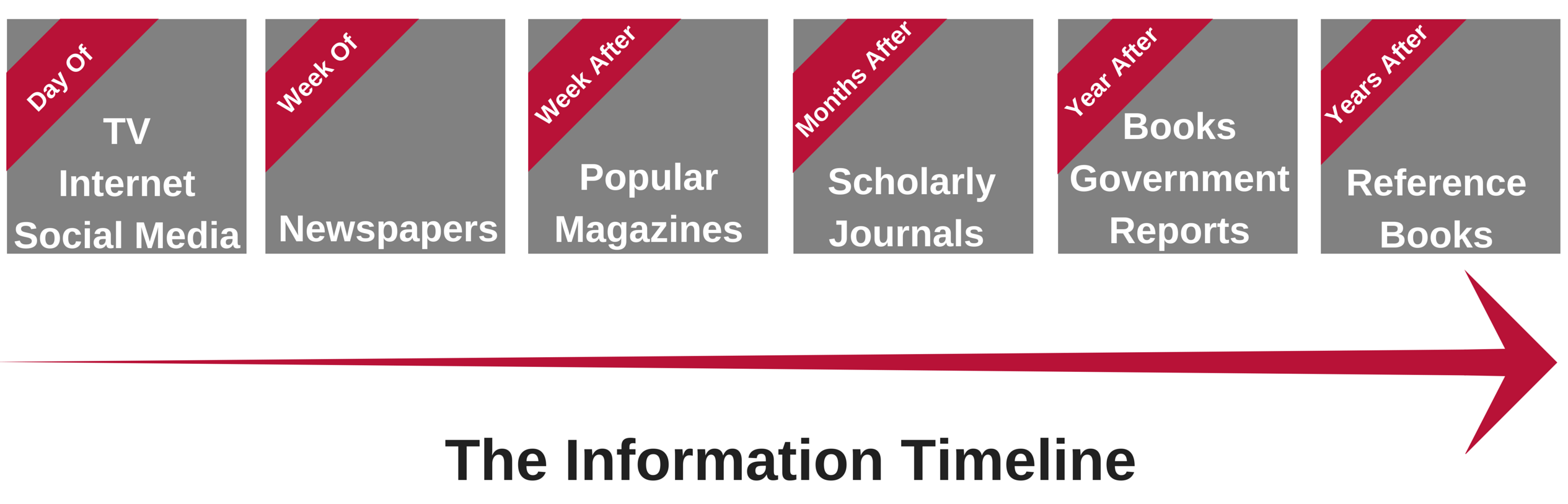
(Ellender Memorial Library, Nicholls State University. Accessed December 5.2025)
Perhaps you’ve never thought about the information creation process. It’s not complicated but important to understand so that you can recognize what types of information are appropriate for your information need, as well as some of the constraints the information has by nature of its format.